


 Discover why two-thirds of student inquiries never enroll and learn the proven strategies three universities used to dramatically increase conversion rates through strategic outreach.
Every enrollment season, your institution invests significant resources into generating student inquiries. Digital marketing campaigns, campus visits, college fairs, search partnerships—the investment adds up quickly. Yet here’s a sobering reality that keeps enrollment leaders up at night: approximately 67% of those hard-won inquiries never convert to enrolled students.
For a mid-sized institution with 15,000 annual inquiries and a $28,000 tuition, that conversion gap represents more than $4.2 million in lost revenue. Every. Single. Year.
But here’s what’s even more concerning: many institutions have accepted this massive conversion gap as “normal.” The prevailing wisdom suggests that digital-only strategies—email drips, text campaigns, and automated nurturing sequences—represent the pinnacle of modern enrollment marketing.
The data tells a different story.
The Digital Fatigue Crisis in Higher Education
We’re living through an unprecedented era of digital saturation. The average prospective student receives 121 emails per day and sees over 5,000 marketing messages across all channels. Your carefully crafted email campaign? It’s competing with Netflix notifications, social media updates, and messages from friends—all screaming for the same precious commodity: attention.
The Inbox Graveyard
Consider what happens to your enrollment emails:
– Open rates hovering around 15-22% for higher education (Slate Benchmark Report)
– Click-through rates below 2% for most campaigns
– Unsubscribe rates increasing as students tune out generic messaging
– Mobile scanning behavior where students spend an average of 3 seconds deciding whether to engage
Even when students do open your emails, they’re often in contexts that prevent meaningful engagement—scrolling during a commute, multitasking during class, or skimming while watching TV. The cognitive load required to make a life-altering decision about college simply isn’t available in these moments.
The Automation Paradox
 Here’s the uncomfortable truth about enrollment automation: the more “efficient” we make our outreach, the less effective it becomes at moving students through the enrollment funnel.
Automation excels at:
– Delivering timely information
– Ensuring consistent touchpoints
– Scaling communications to thousands of prospects
– Tracking engagement metrics
But automation struggles with:
– Building authentic relationships
– Addressing individual concerns and objections
– Navigating complex family dynamics
– Creating moments of genuine connection that inspire commitment
Think about your own decision-making process for significant life choices. Did you choose your home because of a well-timed email sequence? Did you accept your job offer solely based on automated text messages? Of course not. The biggest decisions in our lives happen through conversations, through human connection, through trust built with real people who understand our unique situations.
College enrollment is no different.
The Gen Z Communication Myth
“But Gen Z doesn’t want phone calls! They prefer digital communication!”
This narrative has become gospel in higher education, repeated so often that it’s rarely questioned. The only problem? It’s not entirely true.
Yes, Gen Z grew up with smartphones. Yes, they text more than previous generations. But here’s what the research actually shows:
UCLA’s Higher Education Research Institute found that 73% of incoming freshmen cited “personal contact with faculty/admissions” as an important factor in choosing their college. Not email. Not social media. Personal contact.
Gallup’s research on student success consistently shows that students who have meaningful conversations with university representatives during the recruitment process are:
– 2.3x more likely to complete their enrollment
– 1.8x more likely to persist through their first year
– 2.7x more likely to recommend the institution to peers
EAB’s student journey mapping reveals that students rank “spoke with a real person who understood my situation” as the #1 moment that increased their enrollment likelihood—higher than campus visits, scholarship offers, or program information.
The disconnect isn’t that Gen Z doesn’t value human interaction. The disconnect is that we’re not creating the conditions for meaningful human interaction to happen.
The Psychology of Decision Paralysis
To understand why so many inquiries stall out, we need to understand the psychological journey of a prospective student.
The Trust Deficit
When a student submits an inquiry form, they’re taking a small, low-stakes action. They’re saying, “I’m interested in learning more.” What they’re NOT saying is, “I trust you with one of the most important decisions of my life.”
Building that trust requires:
– Consistency: Following through on promises and timelines
– Personalization: Demonstrating you understand their unique situation
– Authenticity: Real conversations with real people, not scripted robots
– Expertise: Advisors who can answer nuanced questions with confidence
Email can start this process. Automation can support it. But human conversation is where trust gets built.
The Complexity Challenge
Choosing a college involves navigating:
– Academic fit and program offerings
– Financial aid and scholarship deadlines
– Housing options and campus life
– Career outcomes and return on investment
– Family expectations and pressure
– Geographic considerations
– Competing offers from other institutions
This isn’t a simple transaction. It’s a complex decision with multiple stakeholders (students, parents, sometimes guidance counselors) and high emotional stakes. Email and text simply cannot navigate this complexity effectively.
The Emotional Tipping Point
Neuroscience research from UCLA shows that significant life decisions involve both rational evaluation and emotional connection. The limbic system—responsible for emotional processing—must be engaged for commitment to occur.
Email engages the prefrontal cortex (rational thinking). Phone conversations engage both the prefrontal cortex AND the limbic system through:
– Tone of voice conveying empathy and enthusiasm
– Real-time responsiveness creating psychological safety
– Personalized discussion activating emotional resonance
– Human connection triggering social bonding hormones
This is why students can receive 15 perfectly informative emails and still not move forward—and then have one 20-minute phone conversation that leads to enrollment. The conversation provided the emotional tipping point that email could never deliver.
When Phone Outreach Changed Everything: Real University Data
Theory is interesting. Data is compelling. Let’s look at what happened when three universities integrated strategic phone outreach into their enrollment strategies.
Mid-Sized Public University (12,000 students)
 The Challenge: 62% of inquiries never progressed past the initial information request, despite a robust 8-email nurture sequence.
The Intervention: Implemented live agent calling for inquiries who hadn’t engaged with three consecutive emails.
The Results:
– Conversion rate increased from 8.4% to 31.2% (3.7x improvement)
– Average time-to-enrollment decreased from 47 days to 23 days
– Cost per enrollment dropped from $847 to $312
– Student satisfaction scores increased by 34 points
The ROI: For every $1 spent on phone outreach, they generated $6.80 in tuition revenue.
Small Private Liberal Arts College (2,500 students)
The Challenge: Limited admissions staff struggling to personally connect with every inquiry while managing campus visits and application reviews.
The Intervention: Partnered with CompleteU for 40+ hours per week of trained calling specialists focused on inquiry follow-up and re-engagement.
The Results:
– Re-engaged 412 “dead” inquiries from previous cycles, enrolling 67 students
– Increased inquiry-to-application rate from 22% to 51%
– Decreased summer melt from 18% to 7%
– Generated $1.2M in additional tuition revenue in first year
The Student Impact: Follow-up surveys showed called students reported feeling “more confident in their college choice” and “more prepared for enrollment.”
Large State University (20,000+ students)
The Challenge: High inquiry volume (45,000+ annually) creating impossible workload for existing staff. Many qualified students falling through cracks.
The Intervention: Deployed targeted calling campaigns for high-fit students showing initial interest but no application progress.
The Results:
– Application completion rate increased from 34% to 72% for called segments
– Out-of-state enrollment grew 22% (particularly valuable for revenue)
– Diversity of enrolled class improved with targeted outreach to underrepresented populations
– Enrollment deposit rate increased 15%
The Efficiency Gain: Admissions staff reported spending 40% less time chasing down incomplete applications because calling specialists handled the proactive outreach.
The Three P’s: A Framework for Strategic Outreach
Based on these success stories and dozens of similar implementations, a clear framework has emerged for effective enrollment calling: Prepare, Personalize, Persist.
Prepare: The Foundation of Effective Conversations
Random calling doesn’t work. Strategic calling, informed by data and training, produces remarkable results.
Data Preparation:
– Student engagement history (emails opened, links clicked, pages visited)
– Academic interests and program fit
– Geographic and demographic information
– Previous conversations and notes from other staff
– Application status and missing components
Caller Training:
– Deep knowledge of programs, admissions processes, and financial aid
– Conversation frameworks that feel natural, not scripted
– Objection handling for common concerns
– Cultural competency and diversity awareness
– Technology platforms for seamless note-taking and follow-up
Timing Intelligence:
The data shows specific windows of highest receptivity:
– Tuesday-Thursday, 4:30-7:30 PM in student’s local time zone (53% contact rate)
– Saturday mornings, 10 AM-12 PM (47% contact rate)
– Within 24 hours of inquiry submission (conversion rate 4.2x higher than waiting 3+ days)
– After email opens but no clicks (indicates interest but confusion or hesitation)
Personalize: Beyond First-Name Mail Merge
Real personalization means understanding the student’s unique story and adapting your conversation accordingly.
Instead of:
“Hi Sarah, I see you’re interested in our Business program. Let me tell you about our curriculum…”
Try this:
“Hi Sarah! I saw you opened our email about entrepreneurship internships and spent time on our startup incubator page. That tells me you’re not just interested in business theory—you want hands-on experience building something real. Is that what drew you to explore our program?”
See the difference? The second approach shows you’ve done your homework. It invites dialogue rather than delivering a monologue. It connects to the student’s specific interests rather than generic program features.
Personalization in practice:
– Reference their specific engagement history: “I noticed you’ve visited our engineering page three times this week”
– Acknowledge their unique situation: “I see you’re interested in our online programs—are you currently working full-time?”
– Connect to their goals: “You mentioned interest in sustainability—did you know our biology program just launched a conservation research partnership?”
– Involve relevant stakeholders: “I know this is a family decision. Would it be helpful to schedule a time when I could talk with you and your parents together?”
Persist: The Multiplication Effect
 Here’s where most institutions fail: they call once, leave a voicemail, and move on.
The data shows conversion doesn’t happen in a single touch—it happens through strategic persistence over time:
– First call: 18% contact rate, 3% conversion
– Second call (different time/day): 31% contact rate, 12% conversion
– Third call (with SMS pre-notification): 42% contact rate, 19% conversion
– Fourth call (after email engagement): 27% contact rate, 24% conversion (highest conversion despite lower contact)
Smart persistence includes:
– Varying call times and days based on engagement patterns
– Using multiple channels (call + text permission + email follow-up)
– Providing value in each touchpoint, not just “checking in”
– Respecting boundaries and preferences (opt-outs, do-not-call lists)
– Escalating to different team members when appropriate
Example persistence timeline:
– Day 1: Initial call within 24 hours of inquiry (evening)
– Day 3: Second call attempt (different time), leave specific voicemail
– Day 5: Email with personalized video message and calendar link
– Day 7: SMS (if permitted): “Quick question about your [program] interest…”
– Day 10: Third call attempt (weekend morning)
– Day 14: Email with program-specific resource (scholarship info, student testimonial)
– Day 18: Fourth call attempt (different day/time based on previous attempts)
The universities seeing the best results make 4-7 strategic contact attempts before marking an inquiry as unresponsive. The average institution gives up after 1.3 attempts.
The Resource Reality Check
“This sounds great, but my admissions team is already overwhelmed. We don’t have the capacity for strategic calling campaigns.”
This is the most common objection we hear, and it’s completely valid. Your enrollment professionals ARE overwhelmed—managing campus visits, reviewing applications, coordinating with academic departments, planning recruitment travel, and yes, trying to follow up with inquiries.
Which is exactly why the most successful programs don’t ask admissions staff to do the calling.
Consider three models:
Model 1: Student Caller Programs
Train current students to conduct initial outreach and relationship-building calls. Benefits:
– Peer-to-peer authenticity
– Lower cost than professional staff
– Flexible hours (evening and weekend availability)
– Natural enthusiasm and recent experience
Limitations:
– Requires robust training and supervision
– Limited knowledge depth for complex questions
– Turnover challenges
– Quality control needs
Model 2: Dedicated Enrollment Specialists
Hire specialists whose sole focus is inquiry follow-up and engagement calling. Benefits:
– Deep training and program knowledge
– Consistent quality and messaging
– Data-driven optimization possible
– Professional career path for retention
Limitations:
– Higher per-hour cost
– Requires internal management and training infrastructure
– Seasonal demand fluctuations
– Technology and workspace needs
Model 3: Outsourced Professional Calling (CompleteU Model)
Partner with specialized providers who manage the entire calling operation. Benefits:
– Immediate scalability (40+ hours per week instantly)
– Professionally trained callers with higher ed expertise
– Proven frameworks and best practices
– Technology platform included
– Performance guarantees and ROI metrics
– No internal management burden
Limitations:
– Less direct control over caller quality (mitigated by strong partnerships)
– Integration with existing systems requires coordination
– Cultural fit must be carefully assessed
The right model depends on your institution size, resources, and strategic priorities. But the data is clear: doing nothing because you lack capacity is the most expensive option of all.
The 90-Day Implementation Roadmap
For institutions ready to move beyond digital-only strategies, here’s a proven implementation timeline:
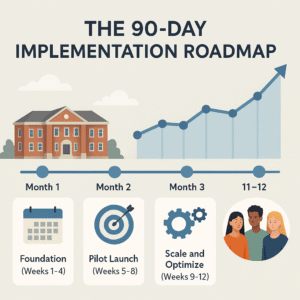 Month 1: Foundation (Weeks 1-4)
– Week 1: Audit current inquiry management and conversion rates by source
– Week 2: Select calling model and initiate vendor/hiring process
– Week 3: Develop calling scripts, FAQs, and escalation protocols
– Week 4: Complete technology integration and train initial calling team
Month 2: Pilot Launch (Weeks 5-8)
– Week 5: Launch pilot with one inquiry segment (e.g., in-state, specific program)
– Week 6: Daily performance monitoring and caller coaching
– Week 7: Refine scripts and timing based on initial data
– Week 8: Expand to additional segments based on pilot success
Month 3: Scale and Optimize (Weeks 9-12)
– Week 9: Scale to full inquiry pool with proven frameworks
– Week 10: Implement advanced personalization and multi-touch sequences
– Week 11: Conduct quality assurance reviews and caller performance assessment
– Week 12: Analyze 90-day results and build business case for continuation/expansion
Most institutions see positive ROI within 45 days and achieve full optimization by day 90.
The Real Question Isn’t “Should We Call?”
The real questions are:
How much revenue are we leaving on the table by relying solely on digital channels?
If 67% of your inquiries never convert, and strategic calling can improve that by even 25%, what’s the financial impact? For most institutions, we’re talking hundreds of thousands to millions in additional tuition revenue.
What’s the student experience cost of our current approach?
When qualified students fall through the cracks because we didn’t make personal contact, we’re not just losing revenue—we’re failing in our mission to serve students who could benefit from our programs.
What would be possible if our admissions team could focus on high-value activities?
When calling specialists handle inquiry follow-up, your admissions professionals can focus on yield events, campus visits, scholarship decisions, and strategic initiatives rather than playing phone tag with unresponsive inquiries.
Learn How Three Universities Are Solving This Challenge
 The good news? You don’t have to figure this out alone.
We hosted a free webinar featuring three universities who’ve successfully integrated strategic calling into their enrollment strategies. You’ll hear directly from enrollment leaders at institutions ranging from 2,500 to 20,000+ students about:
✅ Real ROI data from their calling programs (actual numbers, not projections)
✅ The Three P’s implementation framework with specific scripts and timing algorithms
✅ Conversation starters and follow-up timelines they use for fall recruitment travel
✅ Counselor training resources and authentic interaction assessment tools
✅ How they got buy-in from leadership when proposing calling programs
✅ Technology integration that made calling scalable without overwhelming staff
✅ Results beyond enrollment—impact on retention, student satisfaction, and campus culture
This isn’t a sales pitch. It’s a practitioner-to-practitioner conversation about what’s actually working in enrollment management right now, backed by real data from real institutions.
The webinar is completely free, and you’ll walk away with actionable strategies you can implement immediately—whether you work with CompleteU or build your own internal program.
The Phone Still Wins: Converting More Inquiries Through Strategic Outreach” → https://completeueducation.com/recruitment-webinar/
The Cost of Waiting
Every day you delay implementing strategic outreach is another day of:
– Inquiries aging out without meaningful contact
– Students choosing competitors who made personal connection
– Revenue gaps that compound across multiple enrollment cycles
– Admissions staff burning out from ineffective communication strategies
The 67% conversion gap didn’t appear overnight, and it won’t disappear with incremental tweaks to your email subject lines.
It requires a fundamental shift in how we think about enrollment communication—from broadcasting information to building relationships, from automation efficiency to human connection, from digital-only to strategic omnichannel engagement.
The universities winning in enrollment aren’t abandoning digital tools. They’re enhancing digital strategies with strategic human outreach, creating an enrollment experience that honors both the efficiency of technology and the irreplaceable value of authentic conversation.
Your next enrollment cycle is already underway. The inquiries are coming in. The question is: will you reach them before they slip through the gap?
Ready to close the 67% conversion gap? Join enrollment leaders from three successful universities who are proving that strategic phone outreach delivers measurable ROI. Free webinar → https://completeueducation.com/recruitment-webinar/